GOOZEEZOO
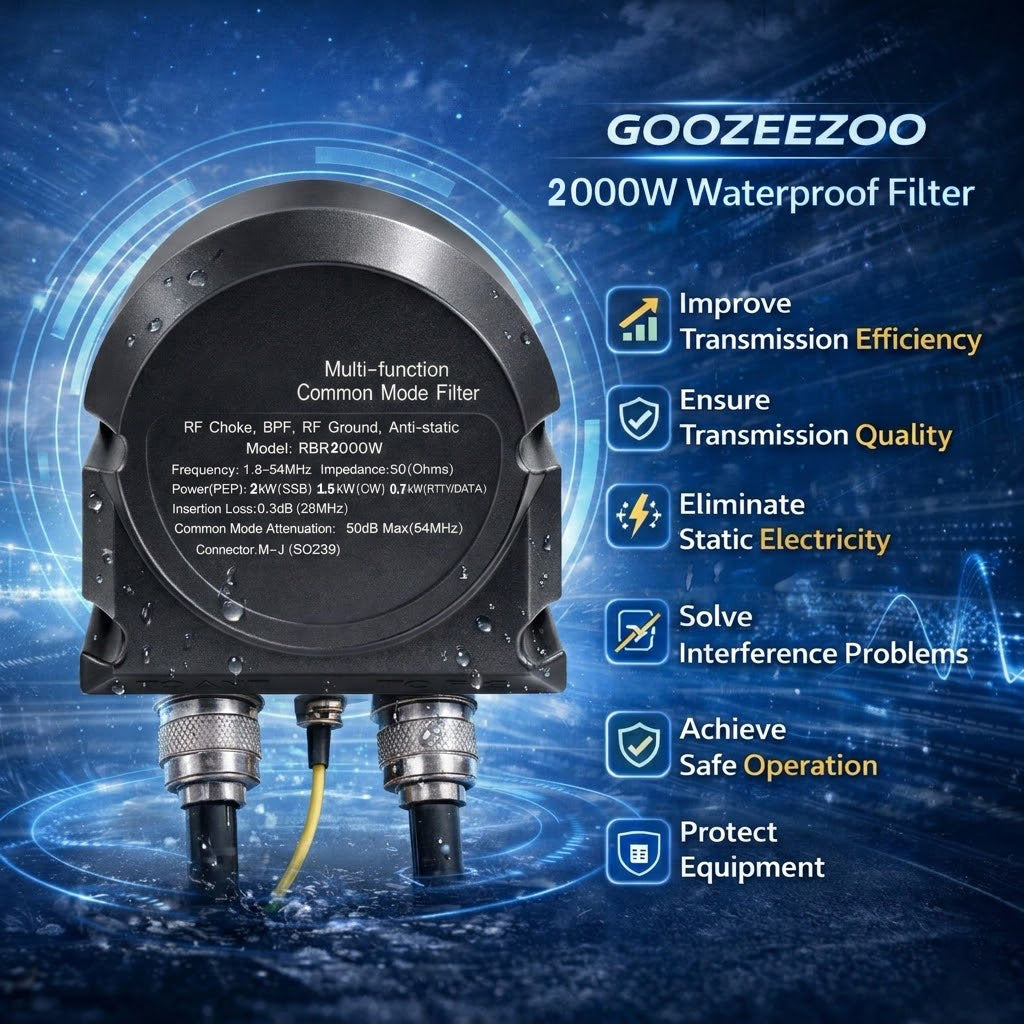
GOOZEEZOO 2000W Common Mode Choke, 1.8–54MHz
GOOZEEZOO 2000W Common Mode Choke, 1.8–54MHz
Couldn't load pickup availability
🚚 Free US Shipping on Orders $100+
GOOZEEZOO 2000W Common Mode Choke – 1.8–54MHz
Reduce unwanted common-mode currents in your amateur radio antenna system with the GOOZEEZOO 2000W Common Mode Choke. Designed for 1.8–54MHz operation, this 50Ω RF choke combines common-mode filtering, static bleed functionality, and high-frequency response compensation in a compact, weather-resistant enclosure.
Suitable for compatible HF and 6-meter antenna systems, including base stations and outdoor amateur radio installations.
Key Features
2000W PEP Power Handling
Designed for high-power amateur radio applications with different power ratings based on operating mode:
-
SSB: Up to 2000W PEP
-
CW: Up to 1200W
-
Digital Modes: Up to 600W
Always observe the applicable power and duty-cycle limits.
3-in-1 RF Choke Design
Combines three functions in one enclosure:
-
Common-Mode Filtering – Helps suppress unwanted RF currents traveling along the outside of coaxial feedlines.
-
Static Bleed Function – Provides a path for static charge dissipation as specified by the product design.
-
High-Frequency Compensation – Incorporates compensation intended to support performance across the operating frequency range.
1.8–54MHz Frequency Coverage
Designed for HF and 6-meter amateur radio applications with a nominal 50Ω impedance.
Features a specified insertion loss of ≤0.3dB at 28MHz and SWR below 1.2 under the manufacturer's stated measurement conditions.
Common-Mode RFI Suppression
Helps reduce unwanted common-mode currents that can contribute to RF interference, feedline radiation, and noise coupling.
Specified attenuation performance includes:
-
Theoretical attenuation: Up to 50dB at 54MHz
-
Reported measured maximum: Approximately 30–35dB at 10–12MHz
Actual suppression depends on operating frequency, installation, and antenna system characteristics.
Weather-Resistant Housing
Features an anti-corrosion, UV-resistant enclosure designed for sheltered outdoor and fixed-station installations.
Flexible Antenna System Integration
Suitable for use with compatible dipole, vertical, and other coax-fed amateur radio antenna systems where common-mode current suppression is needed.
Technical Specifications
-
Brand: GOOZEEZOO
-
Product Type: Common Mode RF Choke
-
Frequency Range: 1.8–54MHz
-
Nominal Impedance: 50Ω
-
SSB Power Rating: 2000W PEP
-
CW Power Rating: 1200W
-
Digital Mode Power Rating: 600W
-
Insertion Loss: ≤0.3dB at 28MHz
-
SWR: Below 1.2 under specified test conditions
-
Theoretical Common-Mode Attenuation: Up to 50dB at 54MHz
-
Reported Measured Maximum Attenuation: 30–35dB at 10–12MHz
-
Enclosure: UV-Resistant, Weather-Resistant Housing
-
Functions: Common-Mode Filtering / Static Bleed / High-Frequency Compensation
Installation & Safety Notes
-
Install the choke at a suitable location in the coaxial feedline according to your antenna system requirements.
-
Use compatible 50Ω coaxial connections and verify connector compatibility before installation.
-
Observe the specified RF power limits for each operating mode.
-
The static bleed feature is not a substitute for proper station grounding, lightning protection, or electrical safety measures.
-
Weather-resistant construction does not necessarily mean the unit is suitable for continuous direct exposure to rain or water immersion.
Frequently Asked Questions
Q: What does a common mode choke do?
It helps suppress unwanted RF currents flowing along the outside of coaxial feedlines, which may reduce feedline radiation and certain types of interference.
Q: Can this choke handle 2000W?
The stated maximum is 2000W PEP for SSB operation. CW and digital modes have lower ratings of 1200W and 600W, respectively.
Q: Does this choke work on the 6-meter amateur radio band?
Yes. Its specified operating range extends to 54MHz, covering the 6-meter amateur radio band.
Q: Can this device replace a lightning arrestor?
No. Its static bleed function does not replace a properly designed lightning protection and grounding system.
Q: Can it eliminate all radio interference?
No. It is designed to suppress common-mode currents. Actual interference reduction depends on the source of interference and the antenna installation.
Share